
Stretch It and It Cools: MIT Breakthrough Could Change How We Manage Heat

By Science Correspondent
Massachusetts Institute of Technology (MIT) researchers have discovered a stretchy plastic-like material that can quickly change how it handles heat, opening the door to smarter clothing, electronics and buildings.
Most materials handle heat in a fixed way. Plastic, for example, traps heat, while stone or marble lets heat move through it more easily. That’s why marble feels colder to the touch than plastic, even when both are at room temperature.
Normally, a material’s ability to move heat can’t be changed unless it is melted down and remade.
But engineers at MIT have now found a material that can switch between these states almost instantly — simply by being stretched.
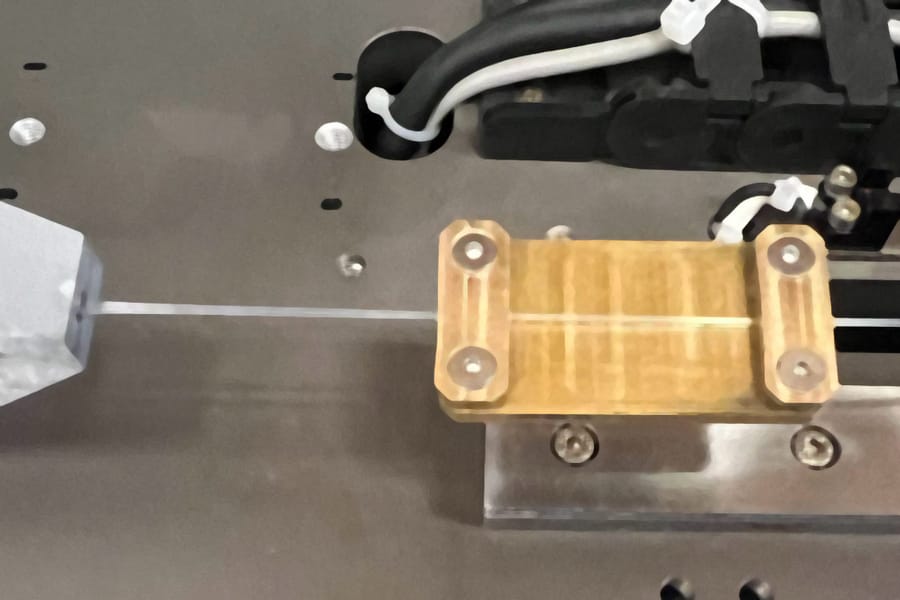
The material, a flexible polymer already used in everyday products, behaves like plastic when relaxed. But when it is stretched, its ability to conduct heat more than doubles, making it behave more like marble. Once released, it returns to its original state. The entire change happens in less than a quarter of a second, making it the fastest heat-switching material ever recorded.
The discovery could lead to products that respond to temperature changes in real time.
For example, fabrics could be designed to keep people warm most of the time, but instantly release heat when stretched by movement. Similar materials could help prevent laptops, phones or even buildings from overheating.
“We need cheap and abundant materials that can quickly adapt to environmental temperature changes,” said Svetlana Boriskina, a senior researcher in MIT’s Department of Mechanical Engineering. “Now that we’ve seen this thermal switching, this changes the direction where we can look for and build new adaptive materials.”
The findings were published this week in the scientific journal Advanced Materials.
The breakthrough came unexpectedly.
The research team was originally looking for sustainable alternatives to spandex, a petroleum-based fabric that is difficult to recycle. While testing different stretchy polymers, they noticed something unusual: the material’s heat flow changed depending on whether it was stretched or relaxed.
At a microscopic level, the material is made up of long chains of carbon atoms. When relaxed, these chains are tangled, blocking the flow of heat. When stretched, the chains straighten and line up, allowing heat to pass through more easily. Crucially, the chains return to their tangled state when the material relaxes, allowing the process to repeat thousands of times without damage.
“That was unexpected,” said MIT graduate student and co-author Duo Xu. “The switch was reversible, and it happened again and again.”
The researchers say the difference in heat flow is similar to the contrast between touching plastic and touching marble — something people can feel instantly.
The team is now working on improving the material further, with the aim of creating fibres that can switch heat flow even more dramatically. If successful, the technology could have wide-ranging uses in clothing, electronics, and construction.
“If we could push this even further,” Boriskina said, “it could have a huge industrial and societal impact.”
The research was supported by several organisations, including the U.S. Department of Energy and the Office of Naval Research.