UWE Bristol Dementia Support Programme Expands Internationally

By Health Correspondent
A support programme developed by a UWE Bristol academic to help people adjust after a dementia diagnosis is now being taken up around the world.
Living Well with Dementia (LivDem) is a group-based course for people who have recently been diagnosed with dementia.
After proving successful in the UK, the programme has been introduced in Japan, Italy and Ireland, with clinicians in Argentina and Chile also expressing interest.
LivDem was set up in 2010 by Professor Richard Cheston, Professor of Dementia Health at UWE Bristol, alongside an NHS colleague. The idea grew out of their work as clinical psychologists, where they saw first-hand how important it was for people to have space to talk openly about their diagnosis and the changes they were experiencing.
Because there were too few psychologists available to run these groups, LivDem was designed so that trained nurses, occupational therapists and social workers could facilitate them.
The groups are only for people living with dementia, with family members and carers attending just an introductory and follow-up session. This was a deliberate choice, to make sure participants could speak freely without their voices being drowned out.
The programme usually runs over eight weeks, with groups of six to eight people.
Research evaluating LivDem has shown that participants often become more comfortable talking about their diagnosis over time. Many report feeling less alone and less frightened, which can make it easier to stay socially active, be open with others and plan for the future.
Interest in LivDem has spread internationally through professional networks, conferences and online searches, as practitioners look for better ways to talk about dementia with their patients. Professor Cheston, from UWE Bristol’s School of Health and Social Wellbeing, says it has been encouraging to see the approach work across different countries, despite wide differences in how dementia services are organised.
Over the years, Professor Cheston has worked with Dr Emily Dodd to further develop LivDem, creating a website and a structured training package for facilitators.
They continue to work closely with group leaders in the UK and overseas to ensure the programme is delivered well. The approach has also been adapted for different settings, and PhD student Jude McClellan is now working with the team to tailor LivDem for people under 65 living with dementia.
LivDem has also been extended to support families.
Dr Natasha Woodstoke, supported by the NIHR Applied Research Collaboration West, has led the development of LivDem-Families, which helps families talk more openly about a dementia diagnosis together. A trial of the approach, led with Dr Karin Buschenfeld, is currently underway in Bristol and Somerset.
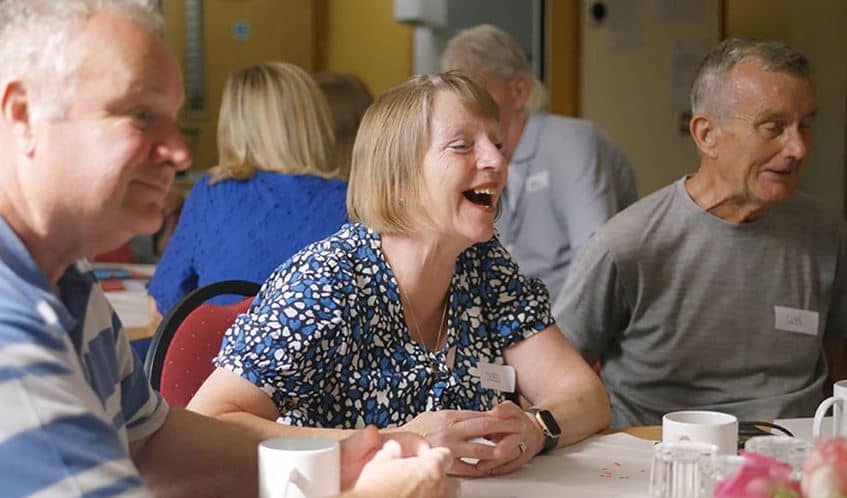
Last year, people living with dementia, their supporters, researchers and facilitators from Mindsong, a Gloucestershire charity that delivers LivDem groups, came together for a celebratory event. Those attending shared their experiences of LivDem, which were captured in a film.
More information about LivDem is available online. Enquiries can be sent to livdem@uwe.ac.uk.