
Britain’s rarest breeding bird has another six reasons to celebrate

By Animals Correspondent
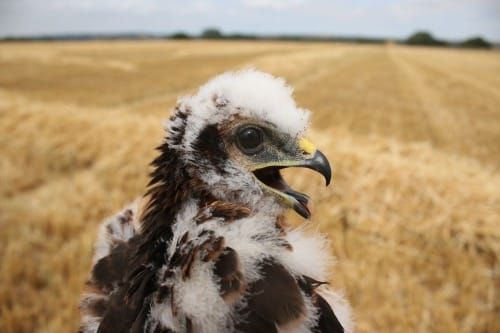
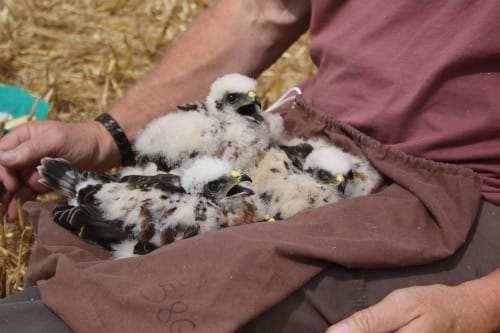
There is some very welcome news for one of Britain’s rarest birds of prey, with six young Montagu’s Harriers successfully raised at a secret location in England this summer.
It is the second year in a row that the birds have bred at the farmland site, following years when successful breeding in the UK had become increasingly rare.
And there is a remarkable story behind this year’s success.
All six chicks were raised by the same ten-year-old male, known as ‘AU’ from his leg ring. After raising four chicks at the site last year, AU returned this spring and attracted not one, but two new females.
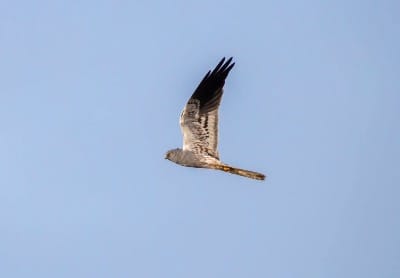
The two nests were only a short distance apart, and AU went on to help feed three youngsters in each.
It is quite an achievement for a bird that was itself once a chick in a protected nest.
AU was ringed in Wiltshire in 2016 and has now become an important bird for the future of the species in Britain.
“He is truly awesome,” says Mark Thomas, Montagu’s Harrier species lead at the RSPB. “He is single-handedly propping up this species in the UK.”
The news is particularly encouraging because Montagu’s Harriers have had a difficult time in Britain.
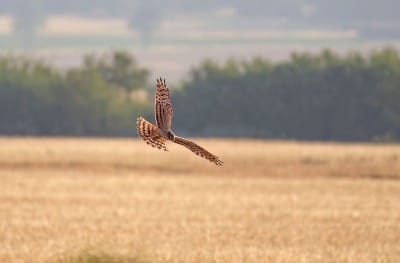
There were nine successful nests in 2011, but numbers then fell sharply. There were no successful breeding attempts between 2020 and 2024, and the species was added to the UK Red List in 2021.
Last year’s four chicks were therefore a significant milestone. This year’s six are an even bigger boost.
The youngsters have been carefully watched by the RSPB and the farmers working with them. Fences were put around the nests to keep out ground predators, and all six chicks were fitted with unique rings in July.
Two of the young females have also been given satellite tags — the first time juvenile Montagu’s Harriers in the UK have been tagged in this way.
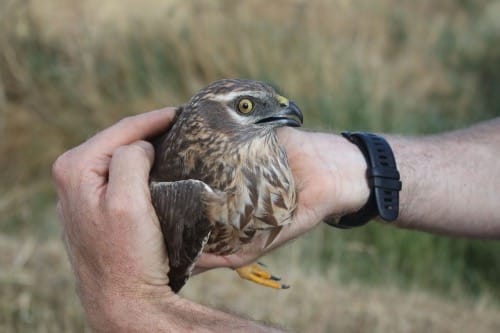
The small, lightweight tags will allow conservationists to follow the birds as they make the astonishing 7,000-mile journey to West Africa for the winter.
It should give the RSPB a much better idea of where the young birds go, how they fare during their first migration and, hopefully, whether they make it back to Britain to breed.
“We are delighted with six flying juveniles this year,” says Mark Thomas. “The satellite-tagging of juveniles for the first ever time should give us a direct insight into their migration, survival and when and where they return to the UK.”
Montagu’s Harriers spend the winter in Africa before making the journey back to Europe in spring.
They nest on the ground, often in farmland, which can leave them vulnerable when crops are harvested before the young birds are ready to fly. Working with farmers to find and protect nests can make the difference between a nest surviving and being lost.
This year, that work has helped six more young birds take to the skies.
And there is another encouraging sign. Three of last year’s youngsters — JJ, JP and JO — were all spotted back in the UK this summer.
 Good News Post
If they return again next year, conservationists hope they could eventually join the small breeding population themselves.
For now, the six new are beginning their own journey south.
Birdwatchers are being asked to look out for Montagu’s Harriers as they leave the UK and to report sightings to the RSPB at montys@rspb.org.uk.
After some very lean years, six young birds — and one rather impressive dad — are giving conservationists plenty of reason to be hopeful.