Sister’s Cancer Diagnosis Inspired Bristol Graduate to Pursue Cancer Research

By Education Correspondent
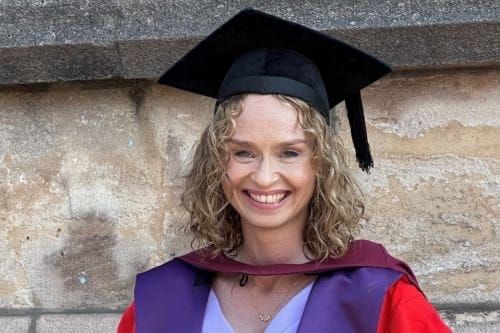
A woman whose sister died from incurable breast cancer has graduated with a PhD after changing careers to help improve cancer diagnosis.
Mel, from Malmesbury, decided to leave behind a successful career running a market intelligence agency after her sister Becca was diagnosed with incurable secondary breast cancer in 2016.
At the time, Mel was balancing work with raising her two young children when she received the phone call that changed the direction of her life.
She said: “My mum phoned to tell me that my sister’s breast cancer had returned. Not only had it come back, but it had spread to her bones, meaning it was incurable. She was just 39 years old.
“Becca’s diagnosis changed my perspective. It brought home how precious good health is and made me think carefully about how I wanted to spend my career.”
Two years later, Mel returned to education, enrolling on a part-time Master's in Health Research at the University of Bristol while continuing to run her business and care for her family.
She admitted returning to university in her late 30s was intimidating.
She said: “I remember queueing up to register for my Master’s degree with a lot of 18-year-olds and wondering ‘what on earth am I doing here?’”
Just four months into the course, Becca died.
Reflecting on that time, Mel said:
“Becca was really excited about what I was doing. Before she died, the first essay I wrote for my Master’s was on breast cancer, and I wrote it for her. I got 90% for it which I think was because I was just so motivated. She asked if she could read it and it was really important that she was able to.”
Mel completed her Master's before receiving Wellcome funding to study for a PhD in Epidemiology at the University of Bristol.
During her doctoral studies, her family suffered another loss when her mother-in-law, Janet, also died from breast cancer.
 Good News Post
Her research has since led to a role as a Postdoctoral Researcher at Queen Mary University of London, where she helps develop tools to support GPs in identifying patients who may have cancer and need urgent referral.
The final project from her PhD was published in the medical journal The BMJ, something Mel described as being “totally beyond anything that I could ever have imagined.”
Following her doctorate, she completed a six-month Wellcome-funded Transition Fellowship at Bristol, working alongside the charity Make 2nds Count to survey people living with metastatic breast cancer about the research they believe should be prioritised.
Mel said: “Returning to university transformed my life. It gave me a career with real purpose and the opportunity to contribute to research that has the potential to improve cancer diagnosis and patient outcomes.
“Looking ahead, I hope to secure funding to carry out research into metastatic breast cancer inspired by the experiences of my sister and mother-in-law and driven by a desire to make a difference for patients and their families.”
Receiving her PhD marks the end of a journey that began almost a decade ago.
She said: “I feel like I have been working towards this for nearly 10 years and I feel such a sense of achievement. Looking back, what I am most proud of was keeping going and having faith in myself that I could manage my studies whilst working and having young children. All the way through, it was about doing things that scared me but doing them anyway. It was a daunting step, but I rediscovered how much I loved learning and challenging myself.
“I owe it to Becca and other people who don’t get the chance to live their dreams to ensure I make the most of every minute I have.”